

Oct . 06, 2025
I’ve walked more packaging floors than I can count, and one thing hasn’t changed: when tablets or capsules fear moisture or oxygen, teams reach for Lucky’s Medicinal Cold-Forming Composite Material. Made in No. 6, Lekai South Street, Baoding, Hebei, China, it’s the workhorse behind those dense, light-blocking blisters you see in high-stakes therapies. And, to be honest, demand has quietly climbed with more moisture-sensitive APIs, tighter shelf-life targets, and the rise of hot climates in last-mile distribution.
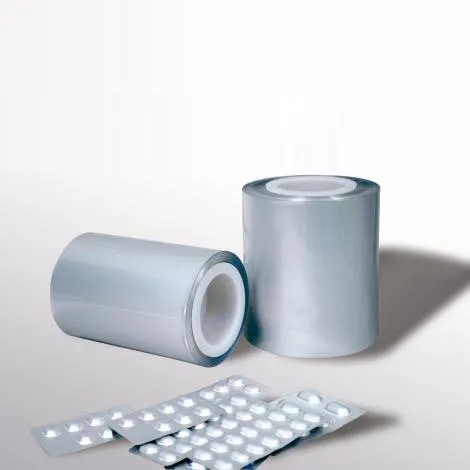
Lucky’s structure is the classic tri-layer: OPA/Al/PVC (with optional PP). In practice, the soft aluminum forms cavities without heat, the polyamide (OPA) lends puncture resistance, and PVC or PP stabilizes forming and sealing. Many customers say it “just works” across lines, which honestly counts as much as any brochure spec.
| Layer structure | OPA(≈25 μm) / Al(≈45 μm) / PVC(≈60–100 μm) or PP(≈80 μm) |
| Barrier performance | WVTR ≈ 0 g/m²·day; OTR ≈ 0 cc/m²·day (ASTM F1249/D3985 limits) |
| Forming depth | Up to around 12 mm, tooling-dependent |
| Pinhole rate | ≤ around 1 hole/m² (Al ≥45 μm), per in-line inspection |
| Roll width / ID | Customized widths; 76 mm core |
| Shelf life (material) | 12 months sealed, 23±2 °C / 50±5% RH |
Materials: pharma-grade OPA, soft Al foil (EN 546 compliant), PVC/PP. Methods: solvent-based lamination, de-curling, aging, high-voltage pinhole detection, slitting. Testing: seal strength (ASTM F88), dye penetration (ASTM F1929) for lidding interfaces, COF (ASTM D1894), appearance, delamination, and stability studies per ICH Q1A. For pharma compliance, look for ISO 15378 and USP packaging chapters.
Advantages include near-zero permeation, deep draw, excellent printability for anti-counterfeit, and consistent cavity geometry. Later on, you can pair with lidding foil HSLs tuned for peel strength targets. In fact, many QA teams like that cold forming foil masks formulation odor and boosts photoprotection.
Color-tinted PVC, PP backsheet (halogen-reduced), Al gauge changes, primer systems for better ink adhesion, and cavity depth optimization. Lucky will also map sealing windows to your specific lidding foil—small detail, big uptime.
A Southeast Asia generics line (38°C/85% RH warehouse) switched to Lucky OPA25/Al45/PVC60. Results after 6 months: carton complaints dropped ≈42%, and stability pulls showed no out-of-spec moisture gain (USP method, n=60). Not flashy, but very convincing. As one line lead told me, “we just stopped worrying.” That’s the quiet magic of cold forming foil.
| Vendor | Barrier | Certifications | MOQ / Lead time | Notes |
|---|---|---|---|---|
| Lucky (Baoding) | ≈0 WVTR/OTR | ISO 15378, ISO 9001; supports USP/EP tests | Around 500–800 kg / 2–4 weeks | Flexible customization, in-line pinhole check |
| Vendor X | ≈0 WVTR/OTR | ISO 9001 | ≈1,000 kg / 4–6 weeks | Limited PP options |
| Vendor Y | High barrier | ISO 15378 | ≈800 kg / 3–5 weeks | Higher price, strong documentation |
Look for conformity with ISO 15378 (GMP for primary packaging), USP /, EN 546 for aluminum foil, and validated sealing per ASTM F88/F1929. Stability should follow ICH Q1A. Lucky’s team can share COAs and typical test data sets—ask early; it speeds tech transfer.
Authoritative citations:
[1] ISO 15378:2017 Primary packaging materials for medicinal products
[2] USP Containers—Performance Testing
[3] USP / Plastic Packaging Systems and Their Materials of Construction
[4] ASTM F88/F88M Seal Strength of Flexible Barrier Materials
[5] ASTM F1929 Detecting Seal Leaks by Dye Penetration
[6] ICH Q1A(R2) Stability Testing of New Drug Substances and Products
[7] EN 546-4 Aluminum and aluminum alloys — Foil
Lucky Medicinal Cold-Forming Composite Material
Buy X-Ray Film: Premium Medical Imaging for Accurate Diagnostics